
You’re juggling a million things: filling beds, training and onboarding staff, welcoming new residents, preparing for your next CQC inspection, responding to emails, updating care plans… oh, and delivering exceptional care to your residents!
Sound familiar? The to-do list never seems to end. And somewhere in the back of your mind, you know there’s more you could be doing to shout out about all the wonderful work you and your team do every day. But when you’re pulled in a dozen different directions, marketing inevitably slips down the priority list.
The good news? Marketing doesn’t necessarily have to mean another big job on an already overflowing to-do list.
If you’re a busy care home manager or owner, my advice is to start small and tackle your marketing in bite-sized chunks. And the perfect place to start? A simple 30-minute marketing MOT to work out what’s already working, where you might be missing opportunities, and what’s worth focusing on next.
So, pop the kettle on, grab a biscuit (or two), and let’s take a look at how to make your marketing work harder without adding more to your workload.
Inspired Watertight Marketing, by Bryony Thomas, I want you to be more specific than simply making sure your marketing works. Using the watertight theory, take a look at the different places where you’re losing potential referrals and residents and fix those weaknesses, rather than assuming you need to spend more money trying to raise awareness of your care home.
The central idea is that you can fill bed vacancies by making better use of the people who already know about you, are considering you to care for their loved one, or already have a family member benefiting from your care and support.
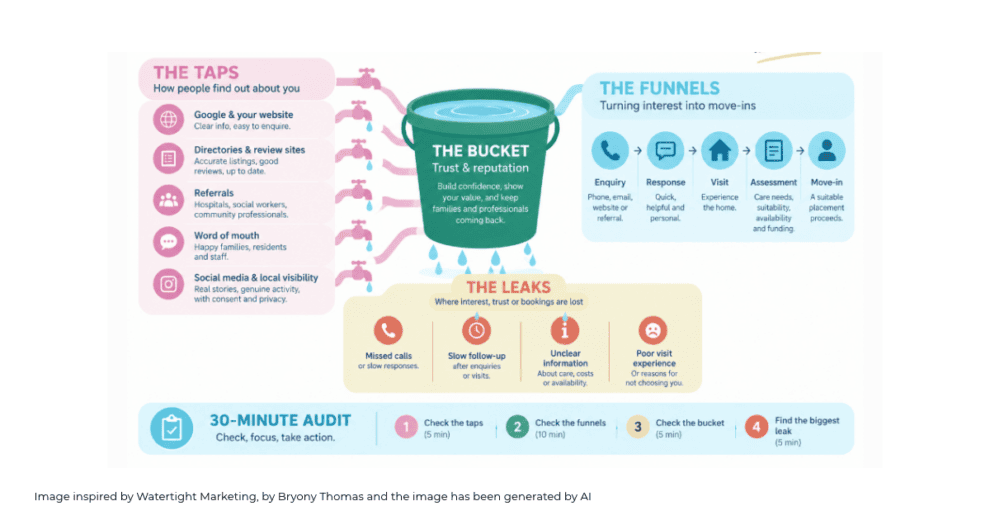
I want you to think of marketing as a bucket of water.
The taps: How potential residents and their families hear about your care home.
The funnels: How an initial enquiry becomes a visit, an assessment, and a filled bed.
The bucket: What builds trust and keeps the home attractive to families, residents, and professional referrers.
The leaks: All the points where interest, trust, or potential bookings are lost, and we don’t want you leaking money!
Step 1: Check your taps – how are people finding you?
Don’t worry, you don’t have to think about all of your marketing activity; you just need to identify where most of your enquiries are coming from.
- Google & your website: Can families find your care home, find your contact details, understand the care offered, and enquire easily?
- Care home directories and review sites: Are your directory listings accurate and up-to-date e.g. carehome.co.uk. Are your photographs current and reviews being responded to?
- Professional relationships: Are local hospitals, social workers, discharge teams and relevant community professionals aware of your care home and its vacancies?
- Word of mouth: Do existing families, residents and staff speak positively about your care home, and is feedback encouraged?
- Social media and local visibility: Does recent post show activities within the home, encapsulate the atmosphere and what makes your home different (with consent from family members and/or residents)? Are you proactively responding to comments?
Ask yourself: Which two marketing channels (or taps) have generated genuine enquiries in the last three months?
Step 2. Check the funnels – what happens after someone contacts you?
This is often where the biggest opportunities hide. A family might find your care home online, but if nobody returns their call promptly or follows up after a visit, the opportunity will likely disappear.
- Do we record every enquiry, including telephone calls and professional referrals?
- Is it clear who is responsible for responding when the manager is busy?
- Do we know how quickly we respond to enquiries?
- Do we know how many enquiries turn into visits?
- Does every family who visits receive an appropriate follow-up?
- Do we record why families decide not to proceed?
- Do we record how the family heard about us? (Was it word of mouth, social media, Google or a care directory?)
Tick the statements that are reliably in place today. An unticked item is something to investigate and improve.
For example: Your care home receives 12 enquiries in a month, but only three visits take place. Before spending more money on more advertising, investigate whether calls are being missed, responses are delayed, or families are not being offered a convenient time to visit.
The issue may be conversion rather than investing in more marketing.
Step 3. Check the bucket – why should families choose your care home?
The bucket represents the things that help a family trust the home and feel confident about choosing it.
The experience
Are families greeted warmly? Does the home feel welcoming during a visit? Do staff explain care arrangements clearly and with compassion?
The evidence
Can families see what daily life is like, how individual needs are met, and what makes the home suitable for their relative?
The relationships
Are families kept informed? Are concerns addressed well? Do professional referrers trust the home to communicate and deliver appropriate care?
Ask yourself:
“If a family compared us with two other local homes, what convincing reasons would they have to choose us?”
If the answer is vague, you may need to make the home’s genuine strengths more visible, rather than create more marketing activity.
Any claims about quality, staffing, specialist care or outcomes should be accurate and supported by evidence such as reviews, case studies and good news stories shared on your website and social media.
Step 4. Find the biggest leaks
Don’t try to fix everything. Choose the one issue most likely to affect suitable enquiries or filling bed vacancies.
- Which problem best describes the home right now?
- Not enough enquiries
- Enquiries aren’t becoming visits
- Visits aren’t becoming move-ins
- Families aren’t choosing us
- We don’t know what’s working
- Who will take the first action?
Home manager
Administrator
Marketing
Regional manager
- When will they act?
Within 48 hours
Within 7 days
Within 30 days
Step 5. Keep your marketing watertight – schedule a weekly check
Once a week, answer these five questions:
- How many enquiries have you received?
- How many enquiries are converting to show around bookings?
- How many families are visiting?
- Is marketing contributing to occupancy?
- What is the main reason for loss of enquiries?
Compare your figures with previous weeks or months rather than judging performance from one week alone. Also consider room availability, care suitability, staffing capacity and seasonal patterns. A care home should seek suitable placements, not simply maximise enquiries regardless of residents’ needs.
Your takeaway
Before you spend more time and money on marketing, take a moment to find out where you might be losing opportunities you already have. Sometimes, a few small tweaks can make a real difference to occupancy without adding to your workload or budget.
Hi, I’m Hannah, a fractional Head of Marketing with a real passion for helping care providers fill beds in the most efficient and cost-effective way possible.
I know how stretched care home managers and owners are, so I believe marketing should work harder for you, not give you another thing to worry about.
Need a helping hand? Get in touch! I’d love to help you make the most of your marketing, without making your to-do list any longer.